 EN

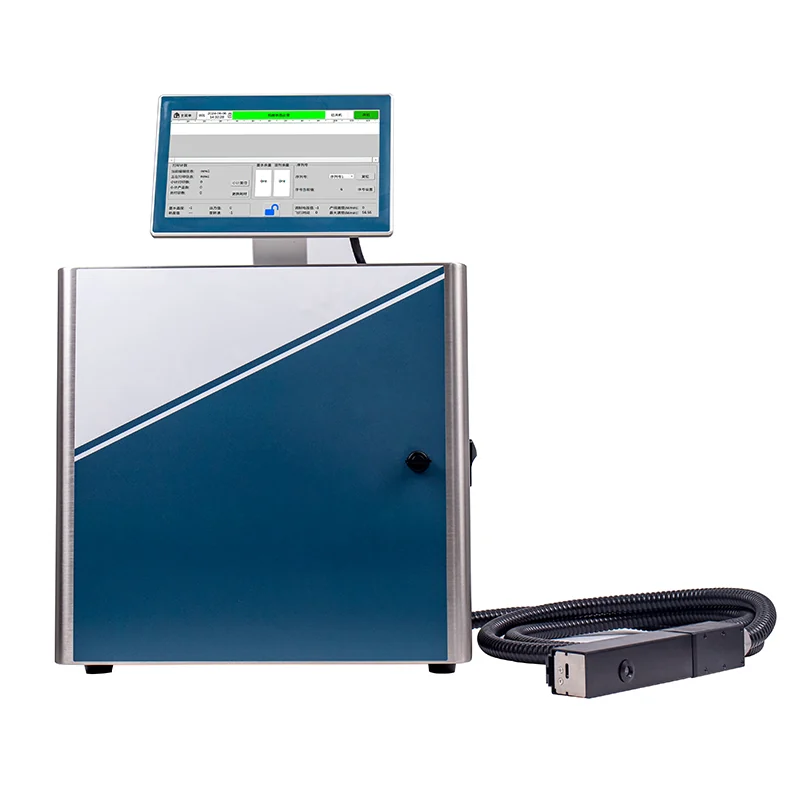
How Continuous Inkjet Printer Speed Adjustment Drives Throughput in Mass Production
Line speed is the master variable in high-volume coding. Continuous inkjet (CIJ) printer speed adjustment enables production teams to change conveyor velocity without stopping to re-tune marking systems—turning the coder from a static component into a responsive, throughput-optimizing asset.
The Physics of Continuous Stream Velocity Control vs. Drop-on-Demand Limitations
Continuous inkjet printer speed adjustment relies on a continuous-stream architecture: a printhead emits 70,000–110,000 charged droplets per second; only those needed for the code are electrostatically deflected onto the product, while unused droplets recirculate to the ink reservoir. This closed-loop fluid dynamics maintains stable jet pressure and velocity—even during rapid line-speed changes. Operators tune pump pressure, nozzle drive frequency, and deflection charge to align drop arrival precisely with fast-moving substrates.
In contrast, drop-on-demand (DOD) technologies generate each droplet only upon command—via piezo or thermal actuation. At high substrate speeds, DOD systems face inherent physical limits: fluid refill time constrains firing frequency, and droplet formation must synchronize exactly with motion. Industrial thermal DOD printers typically max out near 100 m/min, whereas modern CIJ systems sustain legible, high-contrast codes at speeds exceeding 470 m/min (2023 industry benchmarks). Faster stream velocity also shortens flight time, minimizing aerodynamic drift. Because speed adaptation occurs within the continuous stream itself—without refill delays—CIJ supports reliable variable-data printing across a far broader velocity window. This fundamental physics advantage explains why high-throughput packaging lines consistently select CIJ for dynamic, mixed-SKU production environments.
Case Evidence: 23% Throughput Gain via Dynamic Speed Calibration on Packaging Lines
A 2023 deployment by a leading food-packaging integrator demonstrated a 23% throughput gain after implementing dynamic speed calibration. Prior to integration, operators manually slowed or paused the line when switching between product sizes—fixed print parameters caused blurring and illegible lot codes at higher velocities. By connecting the CIJ printer directly to conveyor encoder feedback and mapping PLC speed signals to pump pressure, deflection voltage, and phase timing, the system adjusted drop placement within ±15% speed modulation. Drop placement variation remained below 0.5% across the full range—enabling uninterrupted acceleration. The gain came from fewer conveyor stops, reduced package rejection, and higher average line velocity over shift runs. This case underscores that CIJ speed adjustment’s value extends beyond printhead capability: it hinges on real-time coordination with packaging motion. Such results reflect broad adoption of dynamic calibration in food, beverage, and pharmaceutical lines—where throughput directly determines cost per unit.
Maintaining Print Quality During Continuous Inkjet Printer Speed Adjustment
Maintaining print quality during speed changes depends on jet stream stability and precise ink fluid control—not just faster printhead response. The two subsections below define the operational thresholds and the viscosity–temperature–velocity triangulation required for stable, legible codes at scale.
Jet Stream Stability Thresholds: Ensuring <0.5% Drop Placement Variation Across ±15% Speed Modulation
On high-speed packaging lines, jet stream stability requires tight synchronization among charge electrode timing, printhead position, and conveyor encoder pulses. Any phase lag during ±15% speed modulation shifts drop landing positions—degrading code readability. Field data from 2023 packaging audits show open-loop systems can drift to 2–3% placement error at ramp edges, while closed-loop speed calibration holds variation to 0.4–0.5%. Stable conveyor feedback—delivered via variable frequency drives—and regular printhead-to-encoder calibration are the primary controls. Operators should also monitor satellite droplet formation, as misplaced satellites count toward placement deviation even when the main droplet lands correctly. Quality systems should trigger alarms when placement standard deviation exceeds 0.35%, enabling proactive correction before reaching the 0.5% tolerance limit. This threshold must withstand short acceleration bursts, product gaps, and belt slip—without compromising code contrast or readability. Calibration checks every 4–6 hours minimize drift during extended multi-shift operations.
Ink Viscosity–Temperature–Velocity Triangulation for Consistent High-Speed Performance
Speed changes alter shear conditions in the nozzle, while ambient temperature fluctuations and solvent evaporation shift ink viscosity. Effective CIJ speed adjustment treats viscosity, temperature, and velocity as interdependent variables in a single control loop. In 2023 production ink studies, a 5°C rise altered viscosity enough to disrupt droplet breakoff timing—pushing placement outside the 0.5% quality window. Automated viscometers and integrated ink temperature control systems counteract this drift by dynamically adjusting solvent dosing and heater settings in real time. Fast-drying inks support high-speed lines only if viscosity remains within the nozzle’s optimal jetting range. Therefore, operators must monitor all three axes—not just conveyor velocity—during speed transitions. This closed-loop approach sustains print contrast and code legibility across shifts, seasonal temperature swings, and rapid SKU changeovers. Real-time viscosity trending also reduces manual solvent interventions and unplanned downtime—protecting legibility as throughput increases.
Integrating Continuous Inkjet Printer Speed Adjustment into Smart Manufacturing Systems
OPC UA–Enabled Real-Time Synchronization with PLC-Controlled Conveyor Lines
Continuous inkjet printer speed adjustment integrates seamlessly into smart manufacturing ecosystems through OPC UA (Open Platform Communications Unified Architecture) and PLC-controlled conveyors. Real-time velocity and position data exchange—every few milliseconds—allows the printer to pre-adjust modulation before product spacing changes, eliminating smear and missed codes. Unlike fixed-speed operation, this closed-loop synchronization supports high-volume packaging, electronics marking, and pharmaceutical serialization without line stoppages. In practice, synchronized speed modulation reduces unplanned downtime and operator intervention, delivering repeatable print quality across shifts. The result is a faster, data-driven process where speed changes execute automatically—not manually—aligning the coder with Industry 4.0 principles of interoperability and autonomy.
Future-Proofing Mass Production with Adaptive Continuous Inkjet Printer Speed Control
Adaptive speed control transforms the CIJ printer into a self-correcting production asset. It combines encoder feedback, inline viscosity sensors, and lightweight machine-learning models to predict when a line-speed change will destabilize drop placement—and proactively adjust charge-electrode timing before defects occur. In high-mix packaging, this closed-loop approach reduces speed-related print rejects by up to 14% compared with static manual setpoints (2024 packaging line audit). Mass production gains resilience during rapid SKU changeovers and variable conveyor speeds.
Future-proof lines also deploy edge-based control loops—keeping speed decisions local to the printer to avoid network latency. Aggregated performance data still feeds plant-level MES platforms for analytics and traceability. Digital twins of the nozzle and gutter flow simulate speed ramps before production begins, helping engineers map safe operating windows for new substrates. Early adopters report that adaptive speed modulation sustains 99.2% uptime during peak season (2025 smart packaging benchmark). Over time, the algorithm learns from each ramp—building substrate-specific operating envelopes that enable higher throughput without requalifying print quality. The result is a stable, intelligent coder fully prepared for next-generation serialization, regulatory compliance, and agile manufacturing demands.
FAQs
1. How does continuous inkjet printer speed adjustment improve production throughput?
By allowing real-time adjustments to conveyor velocity without stopping, CIJ speed adjustment eliminates line pauses and increases average line velocity, reducing package rejection and downtime.
2. What are the main differences between continuous inkjet and drop-on-demand technologies?
CIJ uses a continuous stream emitting thousands of droplets per second, while DOD generates each droplet upon command. CIJ supports higher speeds and stable printing across a broader velocity range compared to DOD.
3. How does adaptive speed control reduce print rejects?
Adaptive speed control uses encoder feedback, viscosity sensors, and machine learning to predict line speed changes, enabling proactive adjustments that minimize defects and maintain high print quality.
4. Why is ink viscosity important during speed adjustments?
Changes in speed alter shear conditions in the nozzle and can shift ink viscosity. Precise viscosity control ensures consistent droplet formation and maintains legibility during rapid transitions.
5. What role does smart synchronization play in CIJ systems?
Through OPC UA-enabled real-time communication with conveyor PLCs, smart synchronization ensures speed changes happen seamlessly, reducing errors and downtime in high-volume manufacturing.
Table of Contents
-
How Continuous Inkjet Printer Speed Adjustment Drives Throughput in Mass Production
- The Physics of Continuous Stream Velocity Control vs. Drop-on-Demand Limitations
- Case Evidence: 23% Throughput Gain via Dynamic Speed Calibration on Packaging Lines
- Maintaining Print Quality During Continuous Inkjet Printer Speed Adjustment
- Integrating Continuous Inkjet Printer Speed Adjustment into Smart Manufacturing Systems
- Future-Proofing Mass Production with Adaptive Continuous Inkjet Printer Speed Control
- FAQs