 EN

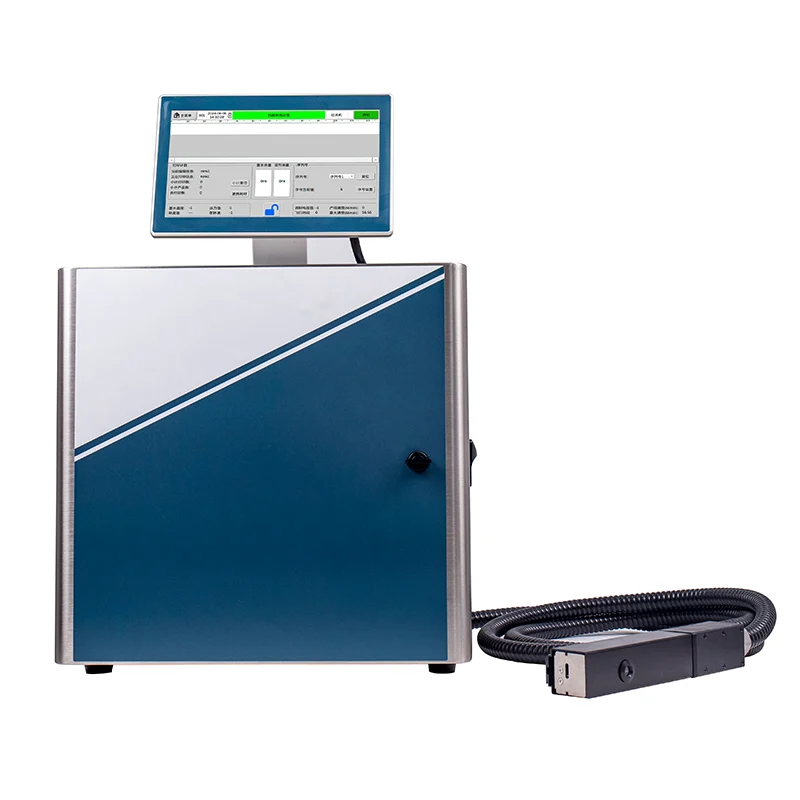
Strategic Integration of Industrial Marking Equipment into Production Lines
Stand‑Alone vs. In‑Line Integration: Matching Marking Deployment to Production Flow
Choosing between stand‑alone and in‑line marking is the first strategic move in integration. Stand‑alone cells sit off the main conveyor and rely on manual part loading—ideal for low‑volume jobs, rework, or pilot runs. Their throughput rarely exceeds a few parts per minute, but they offer flexibility and minimal upfront disruption. In‑line integration, by contrast, hard‑couples the marking station to the automated material flow. A photo‑eye or encoder triggers the print cycle precisely when the product arrives, eliminating handling steps and keeping cycle times under one second.
High‑speed lines cannot tolerate timing drift. A 0.3‑second lag between product detection and mark initiation can cause misaligned codes and line stops. Aligning the marking trigger with the master machine cycle is therefore essential. A 2023 manufacturing‑performance benchmark found that in‑line marking improved first‑pass yield by 14 % and reduced per‑part processing time by 22 % compared to batch stand‑alone operations. For example, an inkminic module riding a linear axis uses real‑time encoder feedback to deliver crisp alphanumeric codes on‑the‑fly at rates above 200 parts per minute. The selection ultimately hinges on target throughput, changeover frequency, and the need for seamless data exchange with plant‑floor networks.
PLC, MES, and ERP Interoperability: Ensuring Seamless Data Handshake
Traceability demands that marking systems communicate fluently across three control layers: the PLC for machine‑level triggers, the MES for work‑order execution, and the ERP for enterprise‑wide data. In a typical cycle, the PLC announces “part in position,” the MES supplies the unique identifier (serial number, lot code), and the ERP logs the event to update inventory. A break in this handshake causes dropped marks or mismatched variable data. On a line running 400 units per minute, a 50‑millisecond lag in SKU‑change propagation can produce hundreds of mislabeled items before an operator intervenes.
Advanced marking platforms—including the inkminic family—rely on standardized protocols such as EtherNet/IP and OPC UA to simplify integration. A 2023 survey of packaging engineers reported that robust interoperability cut manual data‑entry errors by 28 % and shortened changeover time by 35 %. Properly configured, the data path remains encrypted, job data arrives just‑in‑time, and every mark is verified against its digital twin. The result is a closed‑loop quality system that links physical product codes to a secure, auditable record—without adding latency to the production cadence.
Real-Time Communication and Synchronization for High-Throughput Lines
In high-speed production environments, even millisecond-level communication delays can cause misprints or product rejects. The integration of inkminic marking systems demands robust real-time data exchange to keep pace with conveyor speeds exceeding 200 packs per minute. Two critical aspects are selecting the right industrial protocol and eliminating timing drift in continuous motion applications.
Protocol Selection (EtherNet/IP, PROFINET, Modbus TCP) for Low-Latency Inkminic Integration
EtherNet/IP uses CIP (Common Industrial Protocol) and supports implicit I/O messaging with update rates as low as 2 ms when deployed over a well-designed switched network. To avoid broadcast storms, network engineers often isolate inkminic control traffic on a separate VLAN using IGMP snooping, keeping cyclic data packets within microseconds of jitter. For an inkminic print engine, configuring multicast triggers with Quality of Service (QoS) priority on managed switches ensures deterministic delivery of start-of-print signals. PROFINET stands out for ultra-fast cycles: its real-time (RT) channel achieves cycle times of 1 ms, while isochronous real-time (IRT) can reach 31.25 µs, synchronizing the inkminic firing with conveyor encoder pulses—making it the preferred choice for high-throughput lines where every microsecond matters. Modbus TCP, while more cost-effective, lacks native real-time guarantees; however, an inkminic controller with a real-time operating system (RTOS) can pre-buffer print data and use timestamped triggers sent over TCP to reduce jitter. The ideal protocol depends on the plant’s existing backbone: EtherNet/IP is common in North American factories, PROFINET dominates European packaging lines, and Modbus TCP is often adopted for simpler, cost-sensitive integrations.
Mitigating Timing Drift in Continuous Motion Applications
When products move continuously under the printhead, any discrepancy between the encoder’s position signal and the physical trigger point results in print drift. This often arises from variable PLC scan times, propagation delays in the trigger cable, or network latency. In high-speed lines, even a 1-mm misalignment can cause unreadable barcodes; an encoder resolution of at least 4096 pulses per revolution is recommended for inkminic systems handling fluctuating conveyor speeds. Mitigation starts with using a high-resolution encoder directly wired to the inkminic’s hardware trigger input—bypassing the PLC—to achieve response times below 100 µs. For networked configurations, implementing IEEE 1588 Precision Time Protocol (PTP) synchronizes clocks across the EtherNet/IP or PROFINET network, enabling the inkminic system to timestamp encoder pulses with nanosecond accuracy. In Modbus TCP environments, where such synchronization is absent, a dedicated trigger conditioning module that compensates for known delays can maintain acceptable accuracy for moderate speeds. Routine calibration of the print-to-product offset and network latency monitoring ensure consistent mark placement, even at line speeds above 300 packs per minute.
Inkminic-Specific Debugging, Calibration, and Operational Reliability
Thermal and Mechanical Calibration of Inkminic Print Heads for Consistent Mark Quality
Achieving uniform mark quality on fast‑moving substrates demands precise thermal and mechanical alignment of inkminic print heads. Ink viscosity shifts sharply with ambient temperature, so the integrated heating element must be calibrated against a verified reference to maintain a ±1 °C window at the nozzle plate. Mechanical calibration then corrects X‑Y‑Z offset and pitch angle using a granite surface plate and dial indicator, ensuring the 60 µm orifice plate sits perfectly parallel to the product surface. Risk‑based planning tailors the frequency: lines running high‑coverage codes recalibrate weekly, while stable environments may move to bi‑monthly. Automated drift detection via in‑line vision systems can flag when dot placement exceeds 50 µm deviation, triggering an immediate touch‑up cycle without stopping production.
Preventive Maintenance Schedules and Remote Support Protocols for 24/7 Inkminic Deployment
Condition‑based schedules replace rigid time‑based overhauls. Inkminic controllers continuously log nozzle firing counts, ink flow rates, and temperature fluctuations. When a print head exceeds 250 million actuations, the system automatically generates a work order to swap the piezo‑element module—often during planned line gaps. Remote support protocols leverage secure VPN tunnels to allow off‑site technicians to run automated calibration routines, adjust waveform parameters, and perform virtual ink‑system flushes. This remote capability reduces mean‑time‑to‑repair to under four hours for many software‑resettable faults, sustaining true 24/7 deployment without an on‑site specialist.
Automated Verification and Closed-Loop Quality Control
Integrating automated verification and closed-loop quality control directly into inkminic marking systems elevates production reliability by detecting and correcting errors in real time. High-resolution machine vision and sensor arrays instantly compare each mark against digital masters, catching minute defects that manual inspection often misses. Data from these inspections flows back to control parameters—such as laser power or print-head alignment—within milliseconds, enabling automatic adjustments that keep output within specification. This continuous feedback loop reduces defect rates by up to 75% and minimizes scrap in high-throughput packaging and automotive lines. By replacing post-process sampling with real-time process correction, manufacturers shift from reactive quality checks to a proactive, zero-defect approach that protects brand integrity and throughput without human intervention.
Frequently Asked Questions (FAQ)
What is the difference between stand-alone and in-line marking systems?
Stand-alone marking systems are separate from the main production line and rely on manual operations, suitable for low-volume jobs or pilot runs. In-line marking systems integrate directly into automated production lines, enabling higher speeds and seamless workflows.
How do marking systems integrate with PLC, MES, and ERP systems?
Marking systems use protocols like EtherNet/IP and OPC UA to ensure smooth communication. PLC triggers the marking process, MES provides identifier details, and ERP logs the data for enterprise-level traceability.
What industrial protocols work best for Inkminic integration?
EtherNet/IP, PROFINET, and Modbus TCP are ideal protocols. PROFINET provides ultra-fast cycle times for high-speed lines, while EtherNet/IP is commonly used in North America. Modbus TCP is suitable for cost-sensitive setups when real-time guarantees aren't critical.
How is timing drift managed in continuous motion applications?
Mitigating drift involves high-resolution encoders, bypassing PLC latency, and precise synchronization using IEEE 1588 Precision Time Protocol. Calibration and monitoring ensure mark accuracy even for fast-moving production lines.
What maintenance strategies improve Inkminic reliability?
Inkminic systems use condition-based schedules, logging key parameters to trigger maintenance on-demand. Remote support protocols enable off-site troubleshooting and calibration, ensuring 24/7 operational reliability.
Table of Contents
- Strategic Integration of Industrial Marking Equipment into Production Lines
- Real-Time Communication and Synchronization for High-Throughput Lines
- Inkminic-Specific Debugging, Calibration, and Operational Reliability
- Automated Verification and Closed-Loop Quality Control
-
Frequently Asked Questions (FAQ)
- What is the difference between stand-alone and in-line marking systems?
- How do marking systems integrate with PLC, MES, and ERP systems?
- What industrial protocols work best for Inkminic integration?
- How is timing drift managed in continuous motion applications?
- What maintenance strategies improve Inkminic reliability?