 EN

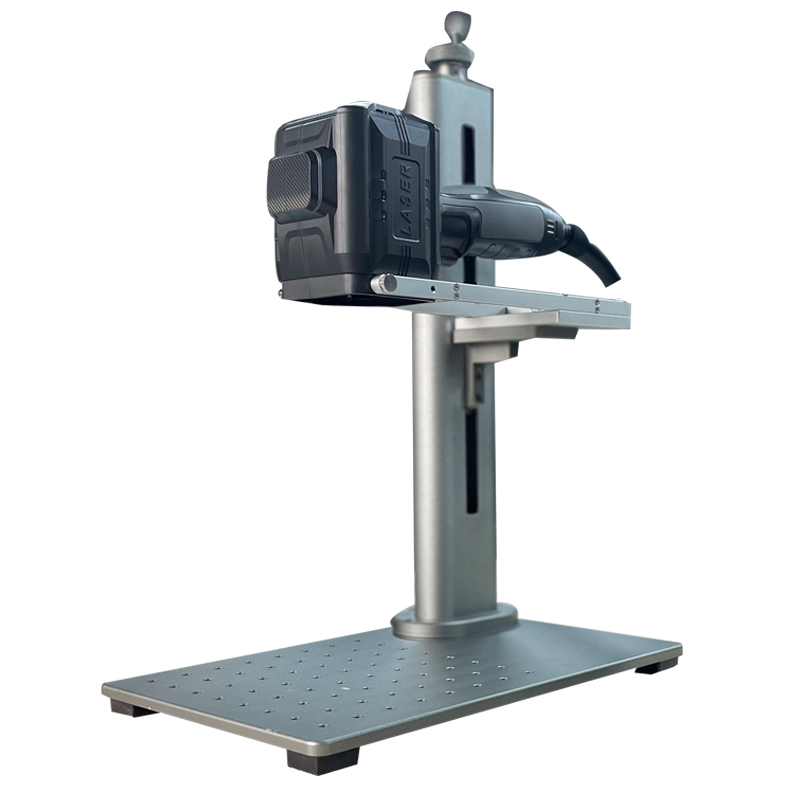
Why Portable Laser Marking Is Essential for Modern Field Operations
In modern field operations, mobility and precision are no longer optional—they are operational imperatives. Portable laser marking systems empower technicians to apply permanent, high-resolution identifiers directly on-site, eliminating the need to dismantle or transport heavy parts to a fixed marking station. This capability slashes downtime, reduces logistical costs, and prevents errors caused by misaligned or temporary labels. For industries like oil and gas, aerospace, and heavy construction—where components are often large, immobile, or located in remote locations—bringing the marker to the workpiece represents a fundamental shift in workflow efficiency.
Portable fiber lasers deliver the same ISO/IEC 15415 Grade A code quality and ±5 µm marking accuracy as stationary systems, ensuring full compliance with serialization and traceability mandates. Their compact design—often under 12 kg—combined with auto-sensing power supplies and intuitive interfaces, allows a single operator to set up and start marking within minutes. This agility accelerates field service tasks and enables real-time customization and permanent asset tagging in dynamic environments, from wind turbine maintenance to pipeline inspection.
The result is a marked reduction in project turnaround times and measurable improvement in asset traceability. On construction sites, tags can be applied immediately after installation—avoiding the risk of missing or swapped labels. In aerospace MRO, strict part-marking standards are maintained without lifting components out of the wing. By eliminating centralized marking bottlenecks, portable laser technology transforms field logistics into a seamless, on-demand process.
How Portable Laser Systems Deliver Precision, Speed, and Compliance On-site
Fiber laser performance in real-world conditions: ±5 µm accuracy, ISO/IEC 15415 Grade A permanence, and up to 7,000 mm/s marking speed
Portable fiber lasers now deliver consistent precision in field environments where vibration and temperature fluctuations once compromised quality. Independent testing verified these systems maintain ±5 µm positioning accuracy—critical for micro-engraving serial numbers on aerospace components—and achieve ISO/IEC 15415 Grade A verification, the highest standard for direct part marking. This ensures barcode and data matrix readability throughout the product lifecycle—even after exposure to solvents, abrasion, and thermal cycling.
With marking speeds up to 7,000 mm/s, portable lasers match fixed-station throughput, eliminating the traditional trade-off between mobility and efficiency. Operators can complete full unit traceability marks in seconds—directly on assembled machinery or large structures—without disassembly. Integrated vision systems instantly verify mark quality and log a digital “birth certificate” for each part, streamlining regulatory reporting. This capability transforms compliance workflows in industries such as medical device manufacturing and defense, where documented traceability is non-negotiable.
Broad material compatibility: metals (aluminum, titanium, Inconel), engineered plastics, PCBs, and anodized surfaces
A portable laser’s fiber source interacts reliably with a wide spectrum of industrial materials—no consumables or surface preparation required. Operators switch seamlessly between applications: laser-annealing titanium aircraft brackets, deep-engraving Inconel turbine blades, or marking anodized aluminum hull plates—all via preset files on the intuitive touchscreen.
A 2022 shipyard field trial demonstrated identical mark contrast on anodized aluminum and glass-reinforced plastic control panels using the same 20W unit. The system also handles delicate electronic substrates safely: low-thermal-impact settings prevent copper trace damage on PCBs, while ABS and PEEK plastics receive crisp, readable data matrices without melting or burring. Adjustable pulse width and frequency provide precise thermal control—ideal for heat-sensitive alloys and thin-walled parts. By replacing multiple marking technologies, one portable laser simplifies job setups, reduces clutter, and shortens training.
Key Design Features That Enable True Portable Laser Deployability
Ergonomic mobility and rapid setup: sub-12 kg weight, integrated handles, Class 4 interlock-free optics, and auto-sensing 110V/220V power
True deployability comes from purpose-built ergonomics and intelligent engineering. Units weighing under 12 kg—some as light as 4.5 kg—enable single-operator transport and one-handed operation. Built-in handles and balanced mass distribution reduce fatigue during extended use. Class 4 interlock-free optics eliminate bulky safety enclosures, allowing safe, direct-on-part marking in open workstations without compromising laser safety.
Auto-sensing power supplies accept 110V or 220V input, automatically adapting to local grids and removing manual voltage switching. Setup is near-instantaneous: plug in, power on, and begin marking—no complex calibration or alignment needed. Rugged, impact-resistant housings withstand drops and vibrations common on construction sites or in maintenance depots. A built-in touchscreen—or optional PC control—lets operators adjust parameters on the fly, eliminating the need for dedicated programming stations. These features make the portable laser equally practical on scaffolding or in a factory bay.
Power and performance trade-offs: selecting 20W vs. 30W portable laser configurations for field throughput, battery runtime, and reflective/thick-alloy marking
Choosing between 20W and 30W configurations hinges on balancing throughput, runtime, and application demands. A 20W fiber laser efficiently handles most common metals—including aluminum, stainless steel, titanium—and anodized surfaces. It achieves high-contrast, permanent marks at speeds up to 7,000 mm/s while consuming less power—supporting 3–4 hours of continuous operation on a typical battery pack. This makes it ideal for all-day field tasks and identification plates.
A 30W laser delivers ~30% faster marking on highly reflective alloys like brass or Inconel and excels at deep engraving on thick components. However, it reduces battery runtime by 20–30% and adds weight that affects mobility. For most identification, tagging, and anodized surface applications, the 20W configuration optimizes efficiency and handling. When marking heavy-gauge metal or requiring high throughput across demanding jobs, the 30W option justifies its trade-offs.
ROI and Operational Impact of Adopting Portable Laser Marking
The financial case for portable laser marking strengthens when viewed through total cost of ownership—not just upfront investment. Traditional methods—dot peen, inkjet, or adhesive labels—carry recurring expenses for consumables like ink, solvents, and stencils. These are eliminated entirely with laser marking. A mid-sized manufacturer can save over $15,000 annually simply by removing those costs, while the permanent, high-contrast mark also reduces rework and rejection rates by ensuring full traceability and compliance.
Downtime from equipment cleaning, nozzle clogs, or label misalignment is virtually eradicated. The laser’s non-contact process requires minimal maintenance and no post-mark curing. Field data show average mark-to-mark cycle times drop by 30–50% compared to manual stamping or adhesive labeling—directly increasing technician throughput. Beyond direct savings, permanent, unfading marks compliant with ISO/IEC 15415 Grade A drastically cut recall costs by enabling instant part identification in the field.
Most organizations achieve full ROI within 12 to 18 months. After that, the system generates pure operational profit for years—transforming a cost center into a strategic asset that improves both field productivity and long-term asset management.
FAQ
What is a portable laser marking system?
A portable laser marking system is a compact and lightweight device designed for on-site and field operations to create permanent and high-resolution marks on various surfaces, ensuring compliance and traceability.
What industries benefit from portable laser systems?
Industries like oil and gas, aerospace, construction, medical device manufacturing, and defense benefit from portable laser systems for their precise, efficient, and on-site marking capabilities.
How accurate are portable fiber lasers?
Portable fiber lasers maintain ±5 µm accuracy with ISO/IEC 15415 Grade A quality, ensuring markings are permanent and comply with serialization and traceability requirements.
What materials can be marked with portable lasers?
Portable lasers work with a broad range of materials including metals (aluminum, titanium, Inconel), plastics (ABS, PEEK), printed circuit boards (PCBs), and anodized surfaces.
What is the difference between a 20W and 30W portable laser?
A 20W laser is lightweight, energy-efficient, and sufficient for most applications, while a 30W laser is faster and better suited for reflective or dense materials but is heavier and uses more power.
How quickly can businesses see ROI from portable laser marking systems?
Most businesses achieve full ROI within 12 to 18 months, as the system eliminates consumables and downtime while improving traceability and compliance.