 EN

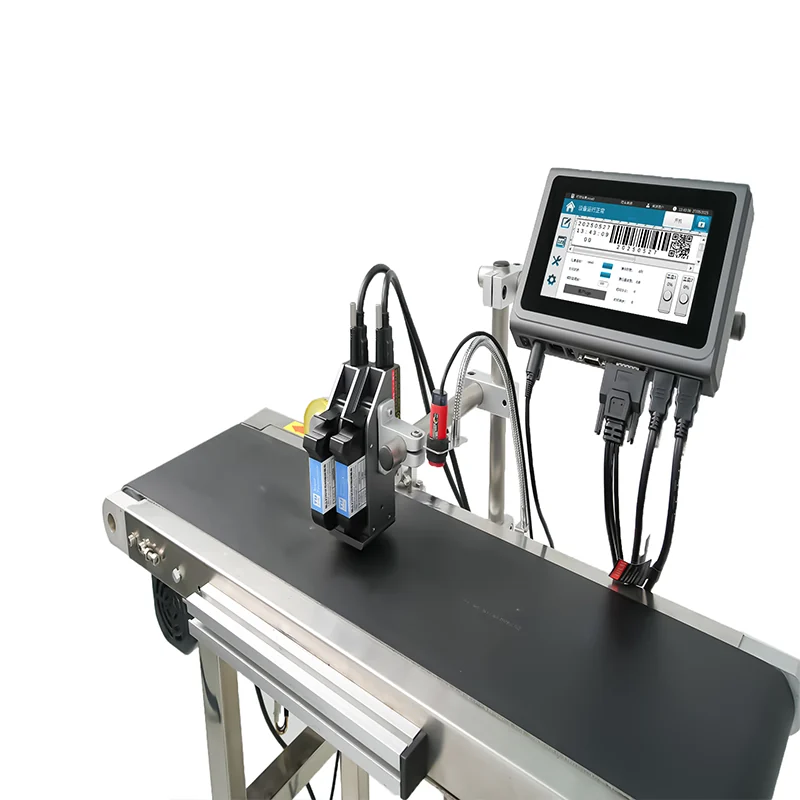
How TIJ Printer Mechanics Define Substrate Compatibility
A thermal inkjet (TIJ) printer ejects ink by rapidly heating a resistor to create a transient steam bubble—propelling a precise droplet through the nozzle. Substrate compatibility hinges on how that droplet interacts with the surface: its ability to wet, spread, pin, and dry before distortion or migration occurs. Unlike continuous inkjet systems, TIJ’s drop-on-demand physics imposes strict limits on ink chemistry, jetting speed, and acceptable surface energy ranges.
Thermal drop-on-demand physics and its surface energy implications
The resistor heats a microscopic ink volume in microseconds, generating a vapor bubble that expands and collapses, ejecting the droplet at moderate velocity (typically 5–12 m/s). Surface tension governs droplet formation and integrity mid-flight, while substrate surface energy determines post-impact behavior. On high-energy surfaces—such as corona-treated polypropylene or coated paper—the droplet spreads evenly into a clean, well-defined dot. On low-energy substrates like untreated PE or PP (<34 dynes/cm), the same droplet beads, retracts, or forms ragged, non-uniform edges. Critically, the thermal pulse also alters ink viscosity inside the nozzle; inconsistent substrate wetting destabilizes this delicate balance, leading to misdirection, satellite droplets, or clogging. As the 2024 Flexible Packaging Surface Energy Standard confirms, reliable TIJ coding requires surface energy within a narrow operational window—typically 38–42 dynes/cm for non-porous films—to ensure both stable jetting and scannable mark formation.
Why ink formulation, droplet velocity, and substrate wetting must align
Successful TIJ coding demands tight alignment between ink chemistry, droplet dynamics, and substrate physics. Water-based inks excel on porous, high-absorption materials (e.g., coated paper), where rapid capillary uptake fixes the dot before spreading. Solvent- or alcohol-based formulations are better suited to non-porous films, offering faster drying and stronger adhesion without requiring deep absorption. Droplet velocity must match throw distance and substrate geometry: excessive velocity risks splashing and satellite formation; insufficient velocity leads to incomplete transfer or poor edge definition. Wetting is governed by contact angle—lower angles indicate better spreading and adhesion. When surface energy falls below the ink’s critical surface tension, pretreatment (e.g., corona or plasma) becomes essential. Done correctly, this triad—ink, velocity, and wetting—delivers sharp, durable, and ISO-compliant barcodes.
Top 3 Substrate Categories Optimized for TIJ Printer Performance
For TIJ printers, flexible films, rigid containers, and coated paper/labels deliver the most repeatable code adhesion, contrast, and scannability. Because TIJ relies on precise thermal actuation and short throw distances (typically 1–10 mm), substrates must support rapid droplet fixation without excessive bleed, beading, or delay-induced smearing. Coated paper and label stocks feature engineered topcoats that absorb water-based TIJ inks quickly—locking dots in place while maintaining edge acuity. These three categories consistently meet the dual requirements of surface energy compatibility and controlled absorbency.
Flexible films: PE, PP, and metallized PET — adhesion, corona treatment, and primer strategies
Polyethylene (PE) and polypropylene (PP) are inherently low-energy, non-porous substrates—often measuring below 34 dynes/cm as-received. Corona treatment reliably elevates surface energy into the TIJ-optimized 38–42 dynes/cm range, enabling consistent wetting and adhesion. Metallized PET offers higher baseline energy and smoother topology but demands fast-dry solvent or specialty TIJ inks to prevent smearing on its non-absorbent metal layer. Many converters apply an in-line primer or acrylic topcoat after corona treatment to further stabilize ink retention and improve rub resistance. While water-based TIJ inks can work on treated films, they require tighter process control—higher surface energy, lower ambient humidity, and longer dwell time—compared to solvent alternatives. Crucially, corona treatment decays over time; test each film lot upon receipt and before production, as energy levels may drop significantly within days.
Rigid containers: PET bottles and aluminum cans — surface energy thresholds and pretreatment best practices
PET bottles typically exhibit 40+ dynes/cm and accept TIJ ink well—if the surface is clean and free of mold-release agents or static dust. Aluminum cans present a different challenge: bare metal rejects water-based fluids outright. A lacquer, varnish, or polymer-coated surface is mandatory for reliable ink adhesion. Compressed or ionized air pre-cleaning removes particulates and condensation that disrupt droplet placement. Rigid substrates also demand precise printhead clearance and sufficient dwell time to ensure full droplet transfer and crisp barcode definition. Industrial-grade TIJ inks—formulated with enhanced binders and resins—improve adhesion on coated aluminum lids and ends. Line speed must stay within the printer’s specified throw distance envelope to avoid satellite droplets or fill gaps. Simple dyne testing and tape-pull adhesion checks provide quick, field-ready validation before launch.
Challenging but Viable Substrates for TIJ Printer Applications
Corrugated board: managing porosity, fiber variability, and ink absorption control
Corrugated board can yield scannable codes with TIJ—but only when ink, process, and substrate variables are tightly coordinated. Its open fiber matrix draws ink vertically away from the print surface, reducing edge definition and lowering ANSI barcode contrast. Fast-drying water-based inks or higher-viscosity formulations help limit lateral bleed and dot gain. Recycled board introduces greater fiber variability, so dynamic drop-volume adjustment during grade changes is often necessary. A light primer or aqueous topcoat slows absorption, improves surface uniformity, and boosts contrast. Board moisture must remain below 9% RH to prevent exaggerated dot spread and loss of resolution. Validate each batch using ANSI barcode grading and rub resistance tests after 24 hours—absorption continues post-print, affecting final durability. Ink penetration may cause show-through on uncoated liners; therefore, test both coated and uncoated grades. Monitor print darkness and dot shape rigorously when switching between virgin and recycled liner stocks.
Concave/curved surfaces: printhead clearance, registration accuracy, and real-time height compensation
Curved surfaces—such as PET bottles or recessed metal panels—challenge TIJ’s narrow operational throw window (commonly 1–2 mm). Radius variation shifts the focal plane relative to the nozzle, causing inconsistent dot placement and distorted barcodes. Mechanical fixtures or part-guiding tooling improve repeatability, while spring-loaded mounts or sensor-driven height compensation maintain optimal standoff across curvature. Registration accuracy depends equally on encoder synchronization and stable part handling; even minor slippage introduces measurable skew or compression. For concave zones, reduce throw distance and select high-contrast, fast-fixing inks to maximize edge fidelity. Test across the full curve—left, center, and right—and verify with a certified barcode verifier to confirm consistent ISO/IEC 15416 grades. Without compensation, stroke width and module height may pass visual inspection but fail automated verification. On high-speed lines, camera-based height sensing enables per-cycle printhead positioning—ensuring reliability at line rates up to 1,200 bpm.
Practical Validation: Testing Substrate Suitability for Your TIJ Printer
Before committing a new substrate to production, run a concise, four-step qualification protocol grounded in TIJ physics and industry best practice.
1. Surface energy measurement
Use calibrated dyne pens on the actual print area—not just the bulk material. Target 38–42 dynes/cm for non-porous films; values below 36 signal need for corona treatment or primer. Retest after treatment and again before production, accounting for decay.
2. Throw distance optimization
Mount the printhead at the manufacturer’s recommended starting gap (usually 1–10 mm, depending on cartridge model). Incrementally adjust in 0.5 mm steps. Evaluate for clean dot edges, complete bar element fill, and absence of satellites—using magnification and verifier-grade imaging.
3. Adhesion and mechanical durability
After full ink cure (per datasheet guidelines), perform tape-pull testing: press 3M™ 610 or equivalent tape firmly over the code and peel at 180°. No visible ink lift indicates acceptable adhesion. For flexible films, flex samples 20 times over a 10-mm mandrel and inspect for cracking or delamination.
4. Environmental simulation
Expose printed samples to downstream conditions—condensation, refrigeration, heat cycling, or pallet stacking pressure—for 24 hours. Assess for smear, fade, transfer, or contrast loss. Record pass/fail results by substrate lot number and treatment date.
This evidence-based routine delivers actionable insight into TIJ substrate readiness—without over-engineering or unnecessary lab dependency.
FAQ
What is a thermal inkjet (TIJ) printer?
A thermal inkjet (TIJ) printer is a type of printer that uses thermal energy to eject ink droplets onto a surface. A resistor heats a small amount of ink, creating a steam bubble that propels the droplet through a nozzle.
How does surface energy affect TIJ printing?
Surface energy determines how well ink droplets spread and adhere to a substrate. High-energy surfaces allow droplets to spread more evenly, resulting in clean and well-defined marks, while low-energy surfaces can cause beading or uneven edges.
What types of substrates work best with TIJ printers?
Flexible films (PE, PP, and metallized PET), rigid containers (like PET bottles and aluminum cans), and coated paper/labels are the best substrates for TIJ printing due to their controlled surface energy and suitable absorbency properties.
Why is corona treatment important for TIJ printing on low-energy substrates?
Corona treatment is crucial for elevating the surface energy of low-energy substrates like PE and PP, enabling better wetting, adhesion, and overall print quality. Without it, TIJ inks may bead, retract, or smudge on these surfaces.
How can substrates be validated for TIJ printer use?
Substrate validation involves measuring surface energy with dyne pens, optimizing throw distance for clear dot placement, testing adhesion with tape-pull tests, and simulating real-world environmental conditions to ensure print durability.
Can TIJ printers handle curved or concave surfaces?
While challenging, TIJ printers can handle curved or concave surfaces with proper mechanical fixtures, part guidance, and height compensation to maintain precise droplet positioning and barcode definition.
Table of Contents
- How TIJ Printer Mechanics Define Substrate Compatibility
- Top 3 Substrate Categories Optimized for TIJ Printer Performance
- Challenging but Viable Substrates for TIJ Printer Applications
- Practical Validation: Testing Substrate Suitability for Your TIJ Printer
-
FAQ
- What is a thermal inkjet (TIJ) printer?
- How does surface energy affect TIJ printing?
- What types of substrates work best with TIJ printers?
- Why is corona treatment important for TIJ printing on low-energy substrates?
- How can substrates be validated for TIJ printer use?
- Can TIJ printers handle curved or concave surfaces?