EN
EN

Desktop Laser Marking Machine Capabilities for Small Precision Parts
Size, power, and resolution limits for sub-millimeter components
Modern desktop laser marking machines achieve remarkable precision on components under 1mm through specialized optical and thermal engineering. These systems reliably mark features as small as 0.1mm—provided material properties align with the laser’s interaction profile. Softer metals like aluminum permit finer detail than hardened steels or carbides, where heat accumulation and reflectivity constrain resolution. Most desktop units operate below 50W, limiting deep engraving on ultra-hard micro-components such as tungsten carbide inserts or ceramic bearings. Resolution typically ranges from 10–30μm, enabled by high-speed galvanometer scanners and diffraction-limited optics—sufficient for legible serial numbers on medical needles, micro-gears, and watch springs. At these scales, thermal management is non-negotiable: even brief energy exposure can induce distortion in parts with low thermal mass.
How micron-level beam focus enables reliable marking on <1mm parts
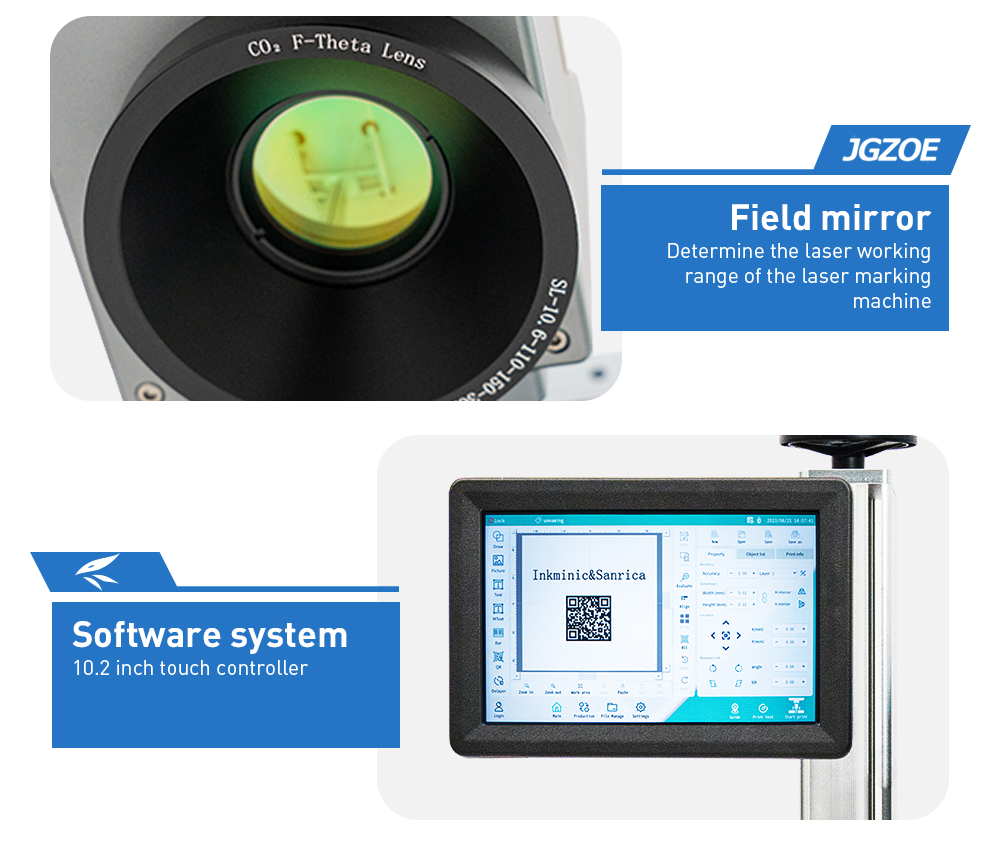
Consistent marking on sub-millimeter components requires a focused beam spot under 20μm—less than one-fifth the width of a human hair. This is achieved using high-NA F-theta lenses that correct spherical and field curvature aberrations across the full marking area. Such tight focus delivers peak power density precisely where needed, enabling crisp, repeatable marks on 0.5mm screw heads or microelectronic contacts without warping or recast layer formation. Dynamic focus control further ensures spot consistency across curved or uneven surfaces, such as jewelry clasps or implantable sensor housings. Leading manufacturers report first-pass yield rates exceeding 98% on titanium surgical tools under 1mm when paired with optimized pulse duration, frequency, and scan speed—confirming that today’s desktop systems meet production-grade reliability for high-value miniature components.
Laser Type Selection: Fiber, UV, and CO₂ for Precision Marking
Fiber vs. UV lasers: Best choices for metals and micro-engineered parts
Fiber and ultraviolet (UV) lasers serve complementary roles in precision marking—defined primarily by wavelength, absorption behavior, and thermal impact. Fiber lasers (1064nm) deliver high peak power ideal for rapid, oxidation-based etching on stainless steel, titanium, and aluminum—making them the standard for durable industrial part identification. UV lasers (355nm), by contrast, enable “cold marking” via photochemical ablation rather than thermal melting, minimizing heat-affected zones. This makes UV the preferred choice for heat-sensitive micro-components: semiconductor wafers, polymer-based microfluidic chips, and coated optical elements where thermal distortion would compromise function. Industry benchmarking shows UV systems consistently achieve <0.1mm feature fidelity on sub-millimeter geometries, while fiber lasers maintain up to five times faster throughput on bulk metal marking tasks. For aerospace micro-fasteners or medical micro-implants, UV prevents micro-cracking and delamination; fiber excels in high-volume traceability marking on robust metallic assemblies.
Material Compatibility: Metals, Plastics, and Ceramics on a Desktop Laser Marking Machine
Desktop laser marking machines support diverse material families—but success hinges on matching laser type and parameters to each substrate’s optical and thermal response. Metals—including stainless steel, aluminum, and titanium—respond predictably to fiber lasers, forming high-contrast, oxide-based marks that withstand sterilization, abrasion, and corrosion. Engineering plastics like ABS, polycarbonate, and PEEK require wavelength-specific coupling: UV lasers minimize charring and edge melting, preserving dimensional stability and surface finish. Ceramics present the greatest challenge due to brittleness and low thermal conductivity; successful marking demands precise pulse control (nanosecond or shorter), reduced peak fluence, and often multi-pass strategies to avoid micro-fractures or subsurface cracking. Modern desktop platforms integrate material-aware firmware that auto-adjusts power, speed, and pulse settings based on preloaded profiles—enabling seamless transitions between metal implants, plastic sensor housings, and ceramic insulators within a single production run.
Common Small Precision Parts Successfully Marked in Practice
Desktop laser marking machines excel at permanently etching identification codes, logos, and technical data onto minuscule components where space is constrained and durability is mission-critical. Their non-contact, digitally controlled process eliminates mechanical stress—ensuring no deformation, burring, or residual vibration during marking.
Optical components (lenses, mirrors), micro-fasteners, and sensor housings
These represent key application categories where desktop systems deliver production-ready results:
- Optical Components: Lenses, mirrors, and sapphire windows require distortion-free marking on highly polished or coated surfaces. Fiber lasers produce high-resolution, low-scatter identifiers directly on glass or AR-coated substrates—without degrading light transmission or wavefront fidelity.
- Micro-Fasteners: Screws, pins, and clips under 2mm diameter demand wear-resistant, legible markings that survive installation torque and environmental exposure. UV lasers generate high-contrast, oxide-free marks on stainless steel and titanium alloys—retaining integrity after passivation, autoclaving, or salt-spray testing.
- Sensor Housings: Miniature enclosures for medical wearables or IoT nodes often integrate metal bodies with PEEK or LCP overmolds. A single UV-capable desktop system can reliably mark UID codes, calibration timestamps, or regulatory symbols on both materials—within a footprint under 1cm²—supporting full-device traceability per ISO 13485 and UDI requirements.
From aerospace micro-valves to neurostimulator leads, this capability underpins regulatory compliance, counterfeit deterrence, and lifecycle traceability where component size once ruled out permanent marking entirely.
FAQ Section
What materials are best suited for desktop laser marking machines?
Desktop laser marking machines work effectively on metals like stainless steel, aluminum, and titanium, engineering plastics such as ABS and PEEK, and ceramics. The choice of laser depends on thermal and optical properties of the materials.
Which laser type is better for marking small precision parts?
It depends on the material. Fiber lasers excel in marking metals, while UV lasers are better suited for heat-sensitive materials, polymers, and micro-engineered components.
Can desktop lasers mark sub-millimeter components reliably?
Yes, advanced desktop systems can mark components under 1mm with high precision, using tightly focused beams and optimized parameters such as pulse duration and frequency.
What are common applications of laser marking on small components?
Laser marking is commonly used for marking optical components, micro-fasteners, and sensor housings, ensuring traceability and durability for miniature parts in industries like aerospace and medical.